
Child Counselling Sharjah: Supporting Your Child's Mental Health During Cancer Treatment
Hearing the word “cancer” attached to your child’s name changes everything in an instant. Along with medical appointments, treatment schedules, and difficult decisions, parents in Sharjah and across the UAE are often left wondering how to protect their child’s emotional world while their physical health is under siege.
September marks Childhood Cancer Awareness Month, and this year’s global theme centres on protecting a child’s potential – not just their survival, but their ability to keep playing, learning, and feeling secure. Globally, more than 400,000 children and adolescents are diagnosed with cancer each year, and survival rates now exceed 85% in many high-income settings. That means more children than ever are living through – and after – cancer, carrying emotional experiences that deserve as much attention as their physical recovery.
This guide walks UAE parents through the emotional impact of a childhood cancer diagnosis, practical ways to support a child’s mental health day to day, and when it’s time to bring in professional child counselling in Sharjah. It’s written for the parent who is exhausted, worried, and simply wants to know they’re doing right by their child.
What Childhood Cancer Does to a Child's Emotional World
A cancer diagnosis is a medical event, but it is also a psychological one. Children process it very differently depending on their age, and their reactions often show up as behaviour rather than words.
According to the American Cancer Society, children undergoing cancer treatment commonly experience sadness, fear, anxiety, and anger, and having those feelings heard and validated matters as much as managing physical symptoms. Younger children may regress – bedwetting, thumb-sucking, or clinginess can reappear – while older children and teens may withdraw, struggle at school, or seem unusually irritable.
Child mental health support in the context of illness is the structured emotional care – through validation, routine, honest communication, and, where needed, professional therapy – that helps a child process fear, disruption, and uncertainty without long-term psychological harm. This is the working definition our team at child and adolescent mental health services uses when building a support plan around a young patient.
Why This Matters Beyond the Hospital
Treatment side effects, hospital stays, school interruptions, and changes in family routine all chip away at a child’s sense of control. Left unaddressed, this can surface later as childhood anxiety, sleep disturbance, or difficulty reintegrating socially – even after the physical illness is resolved. Early, consistent emotional support during treatment is one of the strongest protective factors for a child’s long-term wellbeing.
Age-by-Age: How Children Understand and React to Cancer
Children don’t process a diagnosis the way adults do, and their needs shift significantly by developmental stage.
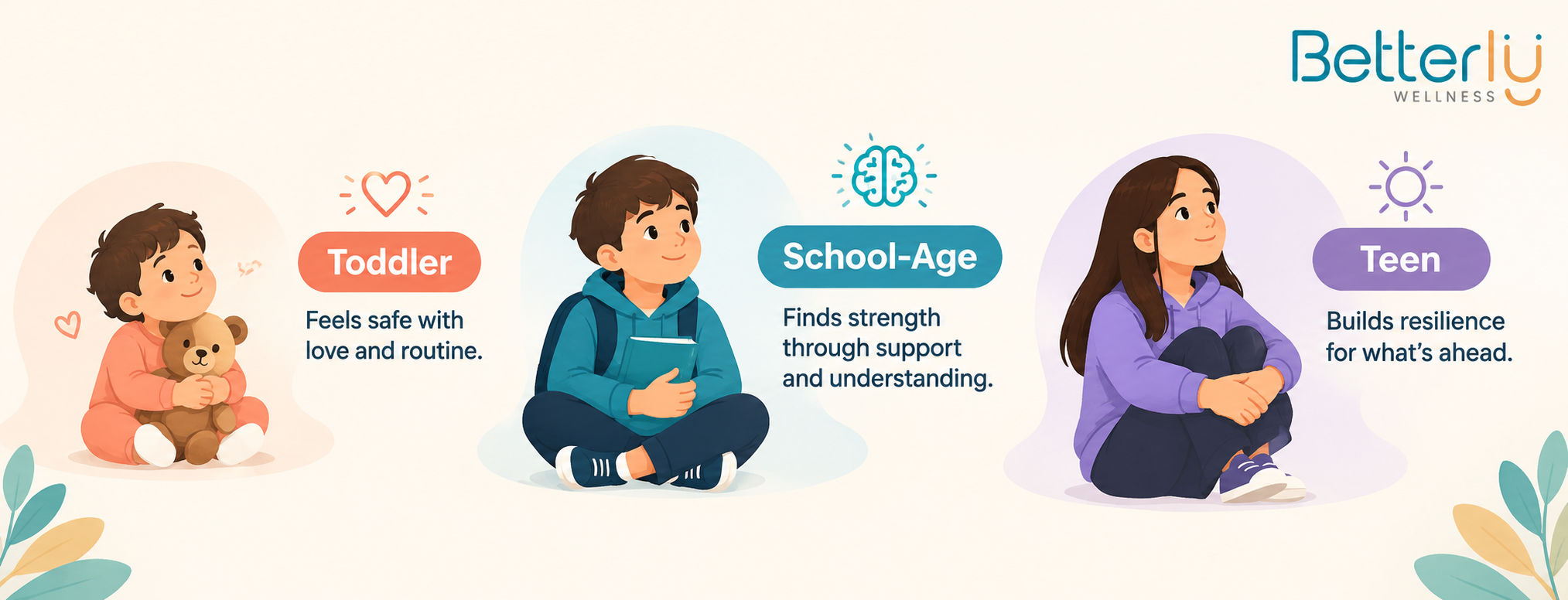
- Toddlers and preschoolers mostly react to disruptions in routine and separation from caregivers rather than the diagnosis itself. Reassurance, physical closeness, and predictable rituals matter most here.
- School-age children can understand more concrete information about their illness and treatment. They often ask direct questions and benefit from clear, honest, age-appropriate answers rather than vague reassurance.
- Teenagers grasp the long-term implications of a diagnosis and may worry silently about their future, appearance, or friendships. They may pull away from parents while leaning on peers, which can look like withdrawal but is a normal coping response.
A trained child psychologist in Sharjah can help parents translate these developmental differences into a support plan that actually matches how their child thinks and feels – rather than a generic script.
Expert Insight: In our sessions with families at Betterly Wellness, one pattern comes up again and again – parents assume silence means a child is coping well, when it often means the opposite. Children frequently protect their parents by hiding distress. A child who seems “fine” during the day but develops stomachaches, nightmares, or sudden clinginess is usually communicating through their body what they can’t yet say in words. Watching for these physical and behavioural signals, not just verbal ones, is often the first real step toward helping a child heal emotionally.
Signs Your Child May Need More Than Family Support
Most children show some distress during and after cancer treatment, and that’s normal. The American Cancer Society notes that professional support becomes important when a child shows severe anxiety, refuses to go to school, expresses blame or guilt, seems persistently low, or shows a drop in self-esteem.
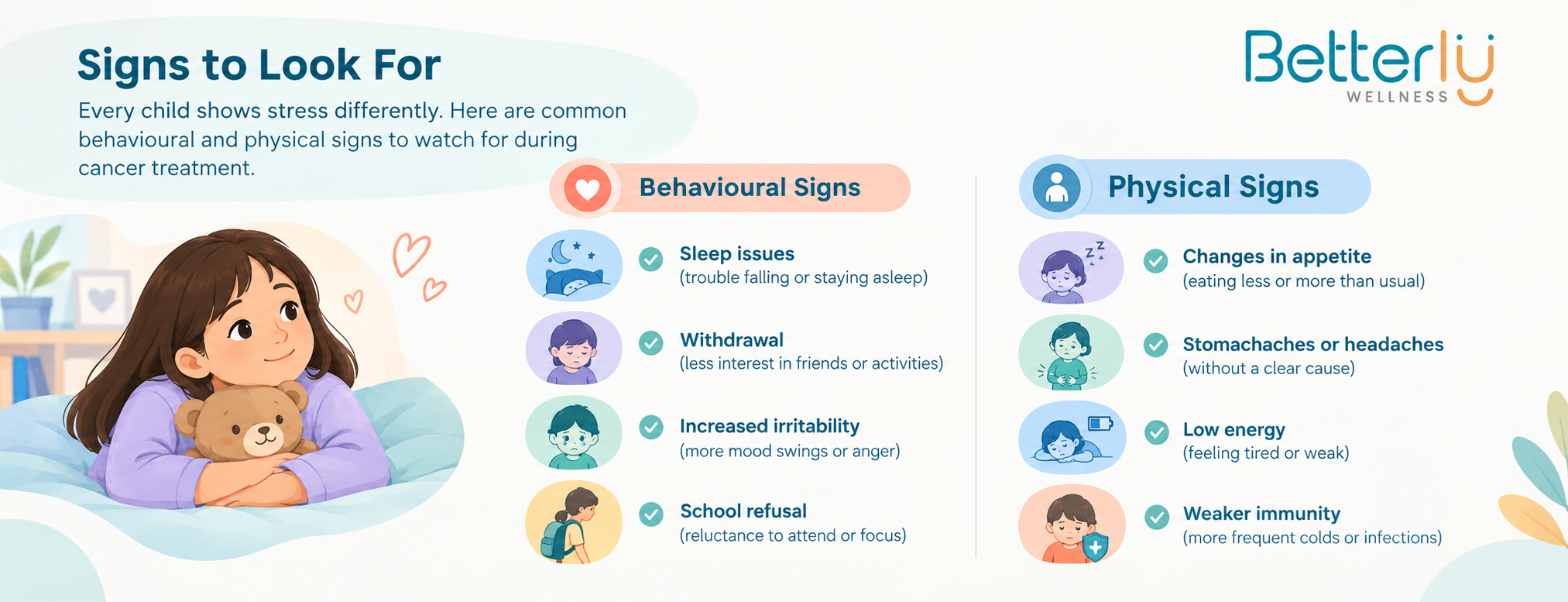
Watch for:
- Ongoing sleep problems, nightmares, or bedwetting beyond the early treatment weeks
- Withdrawal from friends, favourite activities, or family conversations
- Physical complaints (headaches, stomachaches) with no medical cause
- Sudden drops in school performance or refusal to attend
- Excessive fear around medical visits, needles, or hospital environments
- Anger outbursts or regression that doesn’t ease over time
If these patterns persist for more than a few weeks, a psychological assessment in Sharjah can help clarify what a child is experiencing and rule out anything requiring closer clinical attention. Persistent sleep disruption in particular is worth flagging early with a sleep and OCD clinic, since sleep and anxiety often reinforce each other in children.
Early screening and early identification also helps parents catch developmental or behavioural regressions before they become entrenched patterns.
Practical Ways Parents Can Support Their Child's Mental Health

1. Talk Honestly, at Their Level
Children generally cope better when they understand what is happening than when information is withheld. Oncology social workers commonly advise sharing the diagnosis before treatment begins, using simple, factual language, and leaving room for questions rather than a single big conversation. Keeping a diagnosis secret tends to increase a child’s anxiety, not reduce it, because children usually sense that something is wrong regardless.
If these conversations feel overwhelming, individual counselling and psychotherapy sessions can help parents rehearse and refine how they explain diagnosis, treatment, and physical changes in age-appropriate ways.
2. Protect Routine Wherever Possible
Structure gives children a sense of safety when everything else feels unpredictable. Keeping regular mealtimes, school attendance (even part-time), and bedtime rituals – even a simplified version – signals that life continues alongside treatment. Our parent guidance and training sessions often focus specifically on rebuilding manageable routines around a demanding treatment schedule.
3. Make Space for Play and Normal Fun
Play is not a distraction from coping – it is coping. Encouraging a child to engage in games, art, music, or simple movies helps process difficult emotions indirectly and gives their nervous system a break from medical stress.
4. Validate Feelings Without Overpromising
Avoid blanket reassurances like “everything will be fine,” which children often sense are not fully true. Instead, acknowledge the fear directly – “it’s okay to feel scared, and I’m here with you” – while reinforcing that they are surrounded by people taking care of them.
5. Support Siblings Too
Siblings of a child with cancer frequently experience guilt, jealousy, or anxiety of their own, and these feelings often go unnoticed while attention is focused on the patient. Brief daily check-ins with siblings, and involving the whole family in family and couple therapy where needed, helps prevent long-term resentment or emotional isolation within the family unit.
6. Manage Your Own Stress First
Children take emotional cues from their parents. A parent who is visibly overwhelmed, without support of their own, makes it harder for a child to feel calm. Seeking support for yourself – whether through friends, family, or behavior therapy approaches adapted for the whole family – is not a luxury during this period; it’s part of protecting your child’s emotional stability.
Key Takeaways
- Emotional distress is a normal, expected part of a childhood cancer diagnosis – it doesn’t mean something is “going wrong.”
- Children often express distress through behaviour and physical symptoms rather than words.
- Support needs differ significantly by age; a one-size-fits-all approach rarely works.
- Honest, age-appropriate communication reduces anxiety more than protective silence.
- Routine, play, and validated emotions are protective factors that parents can offer daily.
- Persistent signs of distress beyond a few weeks warrant a professional assessment.
- Siblings and parents need support too – family wellbeing affects the child’s recovery.
Family Support Alone vs. Professional Child Counselling
Many parents wonder whether love, patience, and time at home are enough, or whether professional counselling is genuinely necessary. In most cases, the two work best together.
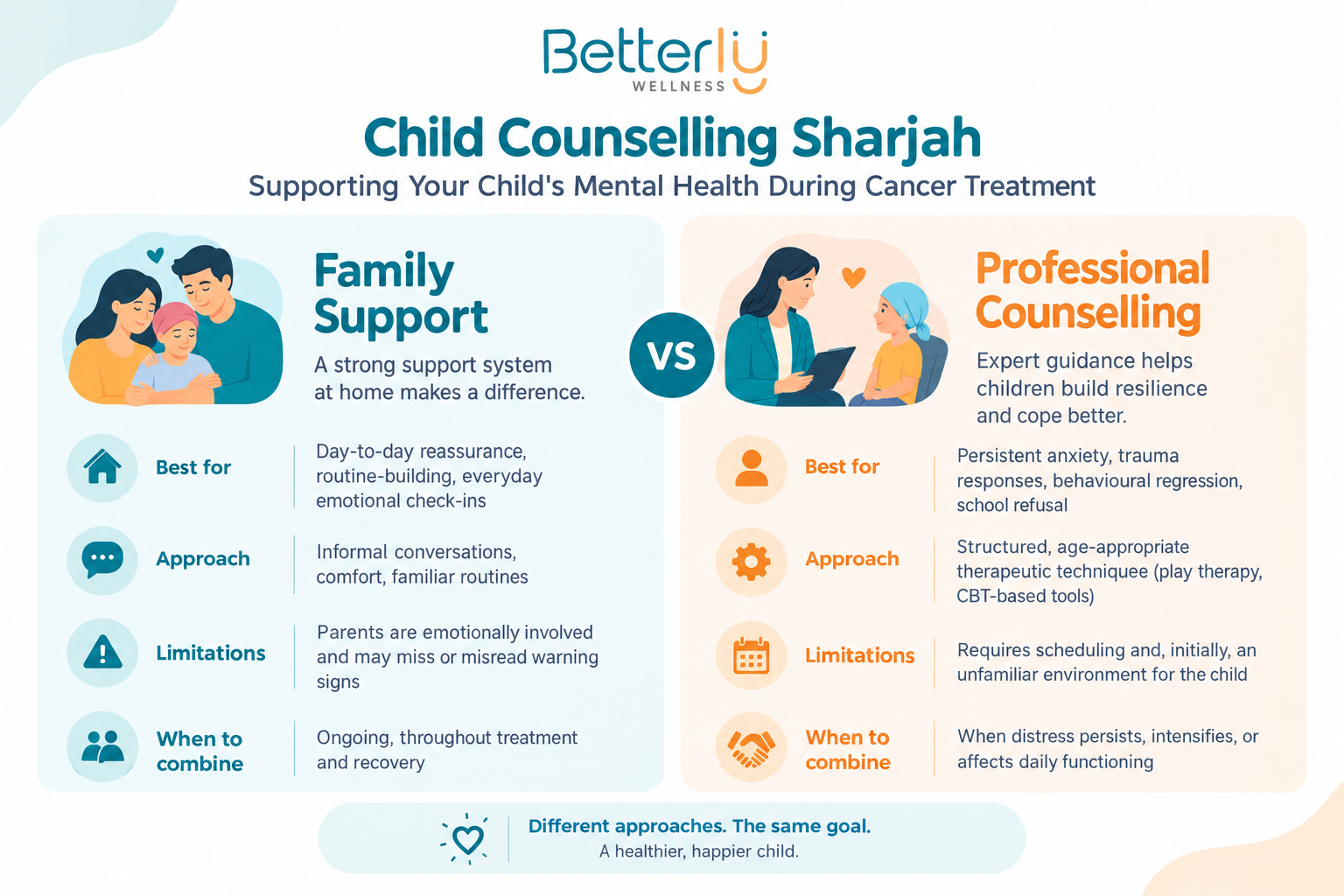
Neither approach replaces the other. Our wellness and preventive programs are often used as a middle ground – lighter-touch, ongoing support that complements what’s already happening at home.
Why Professional Support Matters - And What It Actually Involves
A common misconception is that child counselling is only for “serious” cases. In reality, many families access it proactively, simply to give their child structured tools for processing an unusually difficult year.
Professional child counselling typically involves:
- A confidential intake conversation to understand the child’s history, personality, and current concerns
- Age-appropriate techniques – play-based methods for younger children, talk-based approaches for teens
- Practical coping strategies for anxiety, sleep issues, or medical fear
- Regular parent check-ins so home life and therapy reinforce each other
- Coordination with the child’s medical team where relevant
Where medication or a broader clinical evaluation is being considered alongside emotional support, a psychiatry consultation in Sharjah can run alongside counselling rather than instead of it – the two disciplines usually work as a team around the child.
What to Look for When Choosing a Child Counsellor in Sharjah
Not every therapist is trained to work with children navigating a medical illness. Before booking, it’s worth checking for:
- Paediatric or child-specific training – general adult therapy techniques don’t always translate well to children.
- Experience with medically ill or hospitalised children, ideally including some familiarity with oncology settings.
- Confidentiality and a child-friendly environment that doesn’t feel clinical or intimidating.
- A collaborative approach, including regular communication with parents and, where useful, the child’s medical team.
- Access to diagnostic and psychometric assessments if a more detailed understanding of the child’s cognitive or emotional profile is needed.
- Clear, transparent pricing and session structure, so families can plan around an already demanding treatment schedule.
Common Mistakes Parents Make When Supporting a Child With Cancer
Mistake 1: Hiding the diagnosis to “protect” the child. Why it happens: A natural instinct to shield children from fear or pain. Better approach: Share age-appropriate, honest information early – children usually sense distress regardless, and secrecy tends to increase anxiety rather than prevent it.
Mistake 2: Waiting too long to seek professional help. Why it happens: Parents assume distress will pass on its own, or feel it reflects poorly on their parenting. Better approach: Treat emotional check-ins as routine as medical ones. Early support through child development services is preventive, not a last resort.
Mistake 3: Overlooking siblings’ emotional needs. Why it happens: Attention naturally centres on the child undergoing treatment. Better approach: Build in brief, regular one-on-one time with siblings, and consider family-based sessions if tension or withdrawal appears.
Mistake 4: Making promises that can’t be guaranteed. Why it happens: A desire to comfort a frightened child in the moment. Better approach: Offer honest reassurance about support and care, without guaranteeing outcomes you can’t control.
Mistake 5: Neglecting the parent’s own mental health. Why it happens: Parents feel their needs come second during a child’s illness. Better approach: Recognise that a regulated, supported parent is one of the strongest resources a child has during treatment.
Supporting Your Child Doesn't Mean Doing It Alone
Every family navigating a childhood cancer diagnosis deserves a team around them – medically and emotionally. At Betterly Wellness, our clinical team in Muwaileh, Sharjah works with children and families through some of the hardest chapters of their lives, combining clinical training with genuine warmth so both children and parents feel supported rather than judged.
If your child is showing signs of anxiety, withdrawal, or emotional strain during or after treatment, don’t wait for things to get harder. Book a confidential consultation with our child mental health team and take the first step toward helping your child feel safe again.
Not ready to book yet? You can explore more wellness guides on our blog to learn more about supporting your child’s mental health at every stage.
Frequently Asked Questions
Use simple, honest, age-appropriate language and give them space to ask questions. Research consistently shows children experience less anxiety when told honestly and early, compared to when a diagnosis is hidden from them.
Sadness, fear, anger, and anxiety are all common and expected. Younger children may regress behaviourally, while older children may withdraw or seem irritable. These reactions typically ease with consistent support and routine.
Consider professional support if distress lasts more than a few weeks, involves school refusal, severe anxiety, self-blame, or noticeable drops in mood or self-esteem that don't improve with reassurance at home.
Yes. Siblings often experience guilt, jealousy, or anxiety that goes unnoticed. Brief regular check-ins and, where needed, family counselling help prevent long-term emotional strain within the household.
No referral is typically required. Families can usually book directly with a mental health clinic, and sessions are handled confidentially alongside the child's ongoing medical care.
Play therapy allows younger children to process fear and confusion indirectly, through games, art, or storytelling, rather than requiring them to articulate complex emotions in words they may not yet have.
Maintain routine wherever possible, validate their feelings honestly, keep communication open, involve siblings, and make space for normal play - while watching for signs that professional support may be needed.
External Sources Referenced
- Childhood cancer – Wikipedia
- American Cancer Society: Helping Your Child Adjust to a Cancer Diagnosis
- American Cancer Society: Helping Children When Someone They Know Has Cancer
- AACAP: When a Parent Has Cancer – Tips for Talking to Kids
- International Agency for Research on Cancer (WHO): Childhood Cancer Awareness Month 2026
Content reviewed for medical accuracy against publicly available guidance from the American Cancer Society, AACAP, and WHO/IARC. This article is for general informational purposes and does not replace advice from your child’s medical or mental health care team.
Connect with Us