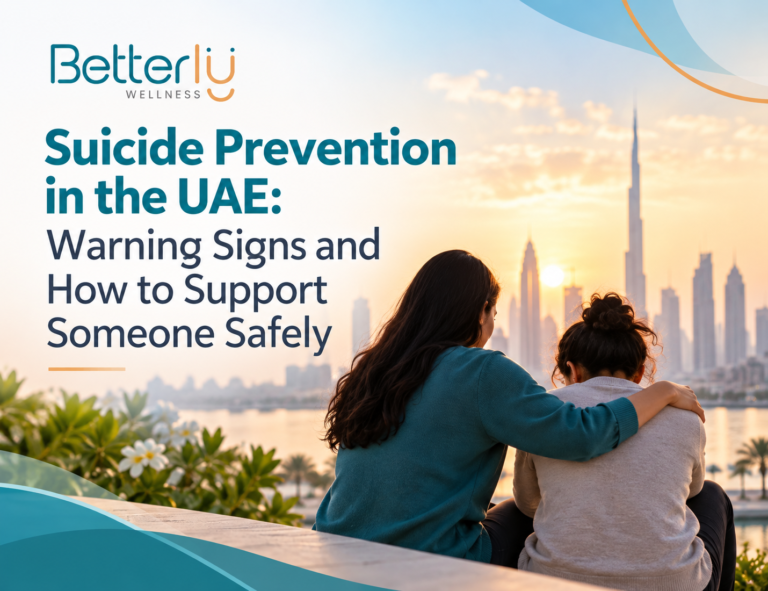

Suicide Prevention in the UAE: Warning Signs and How to Support Someone Safely
You notice that someone close to you has changed. They rarely answer your messages, seem unusually withdrawn, or keep saying that life feels pointless. You want to help, but you are afraid of saying something wrong. Should you ask directly whether they are thinking about suicide? What if they refuse to talk? And where can you find reliable help in the UAE?
These questions matter because suicide prevention often begins with an ordinary conversation that someone is unsure how to start.
Understanding suicide prevention UAE resources means knowing how to recognise concerning behaviour, respond without judgement, and connect someone with appropriate professional care. It also means knowing when emotional support isn’t enough and urgent medical intervention is needed.
A person experiencing suicidal thoughts may not show every warning sign. Some communicate their distress openly, while others hide it from the people closest to them.
This guide explains the signs worth taking seriously, practical ways to support someone, and the mental health services available to people living in Dubai, Sharjah, Abu Dhabi, Ajman, and other UAE communities.
Immediate safety information: If someone has attempted suicide, may act on suicidal thoughts soon, or cannot remain safe, call 998 for an ambulance or 999 for police anywhere in the UAE. Stay with the person if it is safe to do so, and do not rely on a routine counselling appointment for an emergency.
What Is Suicide Prevention, and Why Does It Matter in the UAE?
Suicide prevention involves identifying suicidal thoughts and behaviours early, responding to immediate danger, improving access to appropriate mental health care, and providing continued support to people at risk. Effective prevention includes compassionate conversations, professional assessments, safety planning, evidence-based treatment, and ongoing follow-up.
According to the World Health Organization, more than 720,000 people die by suicide worldwide each year. Its August 2026 guidance emphasises early identification, assessment, management, follow-up, and reducing access to potentially lethal means.
For people living in the UAE, emotional distress can develop alongside relationship difficulties, financial worries, isolation, bereavement, workplace pressure, or problems adjusting to major life changes.
These experiences do not automatically mean someone is suicidal. However, they can contribute to situations where additional mental health support becomes important.
Suicidal thoughts can also occur in people who appear successful, maintain active social lives, or have no previously diagnosed mental health condition.
This is why suicide prevention should never depend on assumptions about how a person looks or behaves.
Who May Need Suicide Prevention Support?
Suicide prevention resources can help:
- People experiencing suicidal thoughts, severe hopelessness, or overwhelming emotional distress.
- Families concerned about a loved one’s changes in behaviour.
- Parents noticing worrying statements or behaviour in teenagers.
- Friends and colleagues who suspect someone may be at risk.
- Individuals living with depression, anxiety, trauma, or other mental health difficulties.
- People supporting someone after a mental health crisis or hospital discharge.
The goal is not to diagnose someone based on a checklist. It is to recognise when concern deserves a conversation, a professional assessment, or an emergency response.
What Are the Most Important Suicide Warning Signs?
Suicide warning signs may include talking about wanting to die, expressing hopelessness, withdrawing from relationships, giving away valued belongings, researching suicide methods, or experiencing major changes in behaviour. Signs are particularly concerning when they are new, escalating, or connected to a recent crisis.
The National Institute of Mental Health identifies changes in speech, emotions, and behaviour as important indicators of potential risk.

1. Verbal Warning Signs
Listen carefully when someone makes statements such as:
- “I don’t see any reason to keep going.”
- “Everyone would be better off without me.”
- “Nothing is ever going to improve.”
- “I feel like a burden to my family.”
- “I don’t think I can handle this anymore.”
Not every expression of sadness indicates suicidal intent. However, repeated references to death, unbearable distress, or hopelessness should prompt a caring, direct conversation.
Do not dismiss concerning comments as attention-seeking or assume someone cannot be serious because they appear calm.
2. Emotional and Psychological Warning Signs
Emotional changes can be difficult to recognise, particularly when a person is trying to maintain their usual responsibilities.
Watch for:
- Persistent feelings of hopelessness or worthlessness.
- Severe anxiety, agitation, or emotional pain.
- Strong feelings of guilt or shame.
- Sudden or extreme mood changes.
- Loss of interest in relationships or previously enjoyable activities.
- Feeling trapped or believing there is no way forward.
A person may experience these symptoms without being suicidal. Nevertheless, they are valid reasons to discuss professional depression support or psychological care.
3. Behavioural Warning Signs
Behavioural changes sometimes provide important clues when someone is unwilling to describe their emotions.
Concerning patterns include:
- Withdrawing from family, friends, or social activities.
- Giving away meaningful possessions.
- Saying goodbye in an unusual or final-sounding way.
- Increased alcohol or substance use.
- Taking dangerous risks.
- Significant changes in sleep or appetite.
- Making preparations associated with ending their life.
- Researching suicide methods or describing a specific plan.
A sudden improvement in mood does not automatically indicate recovery, particularly if other serious warning signs remain present.
These behaviours deserve attention rather than speculation.
4. Warning Signs in Teenagers and Young Adults
Young people may communicate distress differently from adults.
Parents and caregivers might notice a combination of social withdrawal, falling school engagement, intense emotional reactions, disrupted sleep, or concerning online messages.
A teenager who repeatedly talks about disappearing or not wanting to exist needs to be taken seriously.
Rather than beginning with accusations about school performance or screen time, start with concern for their emotional wellbeing.
Young people may find it easier to speak during a walk, quiet drive, or another low-pressure setting.
If there are signs of immediate risk, adult supervision and emergency assessment take priority over a routine appointment.
How Can You Tell When Someone Needs Immediate Crisis Support?
Not every mental health concern requires emergency intervention, but every credible expression of suicidal intent deserves serious attention.
The following comparison can help readers understand appropriate next steps. It is not a substitute for a professional risk assessment.
Situation | Appropriate response |
Persistent sadness, anxiety, or withdrawal without known immediate danger | Offer support and arrange a timely mental health assessment |
Expressions of wanting to die or uncertainty about personal safety | Ask directly about suicide, stay engaged, and seek urgent professional assessment |
A specific suicide plan, stated intention to act soon, recent attempt, or inability to remain safe | Contact UAE emergency services immediately and stay with the person when safe |
Important: Someone may be at serious risk even without openly describing a plan. When you are unsure whether they can remain safe, seek urgent professional help rather than waiting for more warning signs.
How to Support Someone Who May Be Thinking About Suicide
Supporting someone in emotional distress does not require having the perfect words. What matters is recognising the concern, listening seriously, taking appropriate safety measures, and connecting the person with help.
The NIMH recommends five actions: ask, be there, help keep the person safe, help them connect, and follow up.

Step 1: Start an Honest Conversation
Choose a reasonably private setting where the person can speak without unnecessary interruptions.
Begin with something you have genuinely noticed.
For example:
“I’ve noticed you’ve seemed overwhelmed lately, and I’m concerned about you. Would you like to talk about what’s happening?”
Avoid assuming you already know the cause of their distress.
If you believe they might be suicidal, ask clearly:
“Are you thinking about suicide?”
Direct questions do not put the idea into someone’s mind. Research cited by the NIMH indicates that asking about suicide does not increase suicidal thoughts or behaviour.
Step 2: Listen Without Trying to Fix Everything
Someone experiencing emotional pain may already feel misunderstood.
Statements such as “Other people have it worse” or “Just think positively” can discourage further conversation.
A more helpful response is:
“That sounds incredibly difficult. I’m glad you told me. I want to understand what you’re going through.”
Allow silence. Give them time to explain.
You do not need to agree with every belief they express. You can acknowledge that their suffering feels real and overwhelming without reinforcing hopeless conclusions.
Step 3: Take Their Safety Seriously
If someone says they are thinking about suicide, calmly ask whether they have a plan, intend to act soon, or have already taken steps to harm themselves.
If danger is immediate:
- Call 998 or 999 in the UAE.
- Stay nearby when it is safe to do so.
- Do not leave the person alone while arranging emergency help.
- Reduce access to potentially dangerous items if you can do so safely.
- Follow instructions from emergency responders.
Do not promise to keep suicidal intentions secret.
Where necessary, involve emergency professionals or a trusted responsible person, even if the individual initially objects to sharing the information.
Step 4: Help Them Access Professional Mental Health Care
A supportive conversation can help someone feel less isolated, but it does not replace clinical assessment and treatment.
Depending on the individual’s needs, professional care may include psychological assessment, psychotherapy, psychiatric consultation, medication management, or coordinated follow-up.
If the person feels overwhelmed by arranging an appointment, offer practical assistance.
You might help them identify a suitable clinic, make a phone call, or accompany them to a consultation.
For a broader understanding of available treatment pathways, read our guide to mental health services and treatment options in the UAE.
Step 5: Continue Checking In
Support should not end after one conversation or appointment.
A person may feel especially vulnerable following a crisis, during changes in treatment, or after returning home from hospital.
Send a thoughtful message, arrange a check-in, and ask whether they were able to access professional care.
Consistent connection can contribute to suicide prevention by reducing isolation and encouraging continued engagement with support.
Suicide Prevention Resources in the UAE: Where Can You Find Help?
Knowing where to seek assistance is essential, particularly when emotional distress becomes urgent.
Verified UAE support information, October 2026
Resource | Contact or availability | When to use |
UAE Ambulance | 998, nationwide | Immediate medical or suicide-related emergency |
UAE Police | 999, nationwide | Emergency safety response |
Abu Dhabi 800-SAKINA | 800 725462, 24/7 | Mental health support and psychological first aid |
Hospital emergency department | Nearest appropriate emergency facility | Urgent assessment when someone cannot remain safe |
Licensed mental health clinic | Contact the provider directly | Non-emergency assessment, treatment, and ongoing care |
The Abu Dhabi Department of Health announced the 24-hour 800-SAKINA mental health support line in March 2026, providing Arabic- and English-language assistance for psychological concerns, including support for children and families. Availability and eligibility for callers outside Abu Dhabi should be confirmed directly.
The UAE Government confirms that emergency numbers 998 and 999 can be used anywhere in the country.
Finding Mental Health Support in Dubai, Sharjah, Abu Dhabi, and Other Emirates
Residents looking for mental health support UAE services should consider three important factors.
Clinical suitability: Does the provider offer qualified psychiatric or psychological assessment for the person’s needs?
Accessibility: Can the individual reach the clinic, communicate comfortably with the provider, and arrange follow-up care?
Urgency: Is routine outpatient treatment suitable, or does the person’s current condition require emergency services?
For people experiencing persistent symptoms without immediate danger, reviewing available clinical mental health services in the UAE can help clarify the difference between counselling, psychotherapy, and psychiatric care.
Choose the level of support based on safety and clinical need, not simply the nearest appointment.
Why Professional Mental Health Support Matters for Suicide Prevention
Friends and family members can provide emotional reassurance, but they cannot always identify the full extent of a person’s mental health difficulties.
A qualified mental health professional can explore the factors contributing to suicidal thoughts, assess safety, and recommend suitable treatment.
Depending on the individual’s circumstances, care may involve:
Psychological Assessment and Psychotherapy
A clinical psychologist can help identify patterns of emotional distress and recommend therapeutic approaches suited to the person’s needs.
Psychotherapy may address depression, trauma, anxiety, emotional regulation, and difficulties coping with stressful life events.
Evidence-based approaches such as cognitive behavioural therapy (CBT) and dialectical behaviour therapy (DBT) may be considered where clinically appropriate.
If you are unsure which approach is suitable, our guide to counselling versus psychotherapy explains the differences.
Psychiatric Evaluation and Treatment
A psychiatrist can assess mental health symptoms, identify conditions that may require medical treatment, and determine whether medication could form part of the treatment plan.
Psychiatric care may be particularly important when severe depression, significant mood changes, or other psychiatric symptoms are present.
Our article on when to see a psychiatrist in Sharjah provides further guidance for people considering professional assessment.
Collaborative Safety Planning
A safety plan is a personalised document developed with the individual, ideally alongside a qualified mental health professional.
It commonly identifies early warning signs, coping strategies, supportive contacts, professional resources, and measures to reduce access to dangerous items.
Unlike a simple promise not to self-harm, a practical safety plan outlines specific actions the person and their support network can take when distress increases.
Research summarised by the NIMH supports structured safety planning as an important suicide prevention intervention.
Expert Insight: Support Should Match the Person's Immediate Needs

One important principle of suicide prevention is that emotional reassurance and medical intervention are not interchangeable.
A person experiencing persistent sadness may benefit from scheduled psychotherapy. Someone expressing suicidal intent, describing a plan, or struggling to remain safe requires urgent assessment.
The most useful question is not simply whether someone is feeling better today. It is whether they are safe and receiving the level of support their situation requires.
Families should also understand that the absence of visible sadness does not establish safety.
This is particularly important when a person has recently experienced a major crisis or is returning to their normal routine after emergency treatment.
Ongoing communication between the individual, their chosen support network, and healthcare professionals can help identify changing needs.
Common Mistakes to Avoid When Supporting Someone at Risk
Well-intentioned responses can sometimes make difficult conversations harder.
Mistake 1: Assuming Someone Is Just Seeking Attention
Comments about wanting to die should not be dismissed as exaggeration.
Even when suicidal intent is uncertain, the person may be experiencing serious emotional distress.
Better approach: Listen, ask directly about suicide, and help arrange appropriate assessment.
Mistake 2: Promising Complete Secrecy
Someone may ask you not to tell anyone about their suicidal thoughts.
Respecting privacy matters, but immediate safety must come first.
Better approach: Explain compassionately that you may need to involve someone qualified to help keep them safe.
Mistake 3: Waiting for More Obvious Warning Signs
Not everyone communicates suicidal intent openly.
Waiting for a specific statement or dramatic behavioural change can delay important intervention.
Better approach: Take credible concerns seriously and seek professional guidance promptly.
Mistake 4: Assuming One Counselling Session Solves the Problem
Mental health recovery rarely follows an identical timeline for everyone.
Symptoms and support needs can change, particularly during stressful periods.
Better approach: Encourage treatment continuity, regular follow-up, and an agreed safety plan.
Mistake 5: Making Someone Feel Guilty About Their Thoughts
Statements about how much the person would hurt their family can increase shame.
Better approach: Communicate care without blame. Focus on the person’s safety, suffering, and access to effective support.
How Can Families and Communities Strengthen Suicide Prevention in the UAE?
Suicide prevention involves more than responding to an immediate crisis.
Schools, workplaces, healthcare providers, friends, and family members can contribute by creating environments where people feel comfortable discussing mental health concerns.
In UAE communities, this may involve improving awareness of available treatment, encouraging people to seek help before symptoms intensify, and providing culturally respectful support.

Support at Home
Families can encourage honest conversations about emotional wellbeing without forcing individuals to disclose everything immediately.
Parents should treat concerning statements from children and teenagers seriously and seek suitable professional guidance when necessary.
Support in Workplaces
Managers and colleagues should recognise that persistent emotional distress can affect concentration, attendance, relationships, and daily performance.
Employers can make professional mental health resources easier to access while respecting employee privacy.
A colleague should not be expected to diagnose someone or manage a suicidal crisis independently.
Support Within the Community
Community organisations and educational institutions can help reduce stigma by promoting accurate mental health information and providing reliable referral pathways.
People should know where to access crisis support, even if they have never previously used mental health services.
Finding Ongoing Mental Health Care at Betterly Wellness
Seeking help can feel difficult when someone is already emotionally exhausted. Having access to a supportive, qualified clinical team can make the process of exploring treatment options more manageable.
At Betterly Wellness, we provide mental health services through our Sharjah-based medical centre, including clinical psychology, psychiatric consultation, individual counselling, and therapeutic support for adults, children, adolescents, couples, and families.
Our approach centres on understanding the individual rather than treating every person’s emotional difficulties in the same way.
We aim to help individuals and families explore suitable care based on their symptoms, personal circumstances, and clinical needs.
People considering non-emergency treatment can learn more about our specialised mental health care services in the UAE.
We understand that people seeking help may have concerns about confidentiality, treatment choices, and whether their symptoms are serious enough to require professional attention.
Our team can discuss the available services and help prospective patients understand the next steps for arranging a consultation.
How to Contact Our Clinic
Betterly Wellness Medical Centre
Office No. 101, Al Maha Building (Old DIB Building), Muwaileh Commercial, Sharjah, United Arab Emirates.
Phone: +971 56 666 7398 Alternative: +971 6 530 2388 Email: hello@betterlywellness.com
Contact our team to enquire about available appointments and mental health services.
These clinic details and the listed service categories are published on the official Betterly Wellness website.
Our routine clinical enquiry channels are not a replacement for emergency services. If someone may harm themselves imminently, contact 998 or 999.
Key Takeaways: Suicide Prevention Starts With Awareness and Action
Effective suicide prevention involves recognising concerning changes, taking expressions of suicidal intent seriously, and helping people reach an appropriate level of care.
Keep these principles in mind:
- Suicidal thoughts may occur with or without a previously diagnosed mental health condition.
- Warning signs can involve speech, emotional changes, withdrawal, or unusual preparations.
- Asking directly about suicide is appropriate when you are concerned.
- Listening without judgement can help someone share what they are experiencing.
- Immediate danger requires emergency intervention, not a routine appointment.
- Professional assessment, treatment, safety planning, and follow-up are important parts of ongoing prevention.
- UAE residents can access emergency services nationwide through 998 and 999.
A person does not need to explain their distress perfectly before receiving help. A concerned
Frequently Asked Questions
Early suicide warning signs can include persistent hopelessness, withdrawing from loved ones, talking about being a burden, major mood changes, or losing interest in everyday activities. Giving away belongings or discussing suicide plans may indicate more urgent risk. Seek professional guidance whenever concerning signs appear or intensify.
Listen without judgement, ask directly whether they are thinking about suicide, and encourage professional assessment. Do not dismiss their feelings or promise secrecy. If they have immediate intent, a specific plan, or cannot remain safe, stay with them when possible and contact UAE emergency services.
For an immediate suicide-related emergency anywhere in the UAE, call 998 for an ambulance or 999 for police assistance. Explain the situation clearly, provide the person's location, and follow the operator's instructions. Do not delay emergency care while searching for an ordinary counselling appointment or waiting for symptoms to improve.
Yes. Research indicates that asking someone directly about suicide does not cause or increase suicidal thoughts. A calm, compassionate question can create an opportunity for honest communication. Listen carefully to the answer, ask about immediate safety, and involve qualified professionals when there is concern about suicide risk.
Appropriate depression treatment can address symptoms that may contribute to suicidal distress. Depending on the person's needs, treatment may include psychotherapy, psychiatric care, medication, and ongoing monitoring. However, suicide risk is not limited to depression. Anyone experiencing suicidal thoughts needs an appropriate assessment, regardless of their diagnosis.
Emergency services are available across all seven emirates through 998 and 999. Licensed hospitals and mental health providers also offer assessment and treatment services. Abu Dhabi's 800-SAKINA hotline provides round-the-clock psychological support. Residents should confirm service eligibility, availability, language options, and appointment arrangements with individual providers.
Someone experiencing suicidal thoughts should seek prompt professional assessment, even when they are uncertain about acting on those thoughts. A psychiatrist can evaluate symptoms, assess risk, and recommend treatment. If the person has immediate intent, a plan, or cannot remain safe, emergency assessment is needed rather than a routine appointment.
Connect with Us