Counselling vs Psychotherapy:Which One Do You Need in the UAE?
There are times when life appears manageable from the outside but feels much harder internally. You may still be working, caring for your family, meeting deadlines, and fulfilling daily responsibilities, yet something does not feel right.
Perhaps you have been feeling anxious, emotionally drained, disconnected, overwhelmed, or unlike yourself. You may know that speaking with someone could help, but you are unsure where to begin.
Should you choose counselling or psychotherapy?
The terms are often used together, and there can be some overlap between them. However, they may differ in their focus, depth, goals, and likely duration. Understanding those differences can help you choose the most appropriate form of mental health therapy.
Betterly Wellness is a multidisciplinary mental health clinic in Muwaileh Commercial, Sharjah. Its services include counselling, psychotherapy, clinical psychology, psychiatry, psychological assessment, and support for couples, families, children, adolescents, and adults.
Quick answer: Counselling often focuses on a specific current problem and practical coping strategies. Psychotherapy may explore longer-standing symptoms, past experiences, and recurring emotional or behavioural patterns. The distinction is not always strict, so a professional assessment is the best way to choose.

Table of Contents
Counselling vs Psychotherapy at a Glance
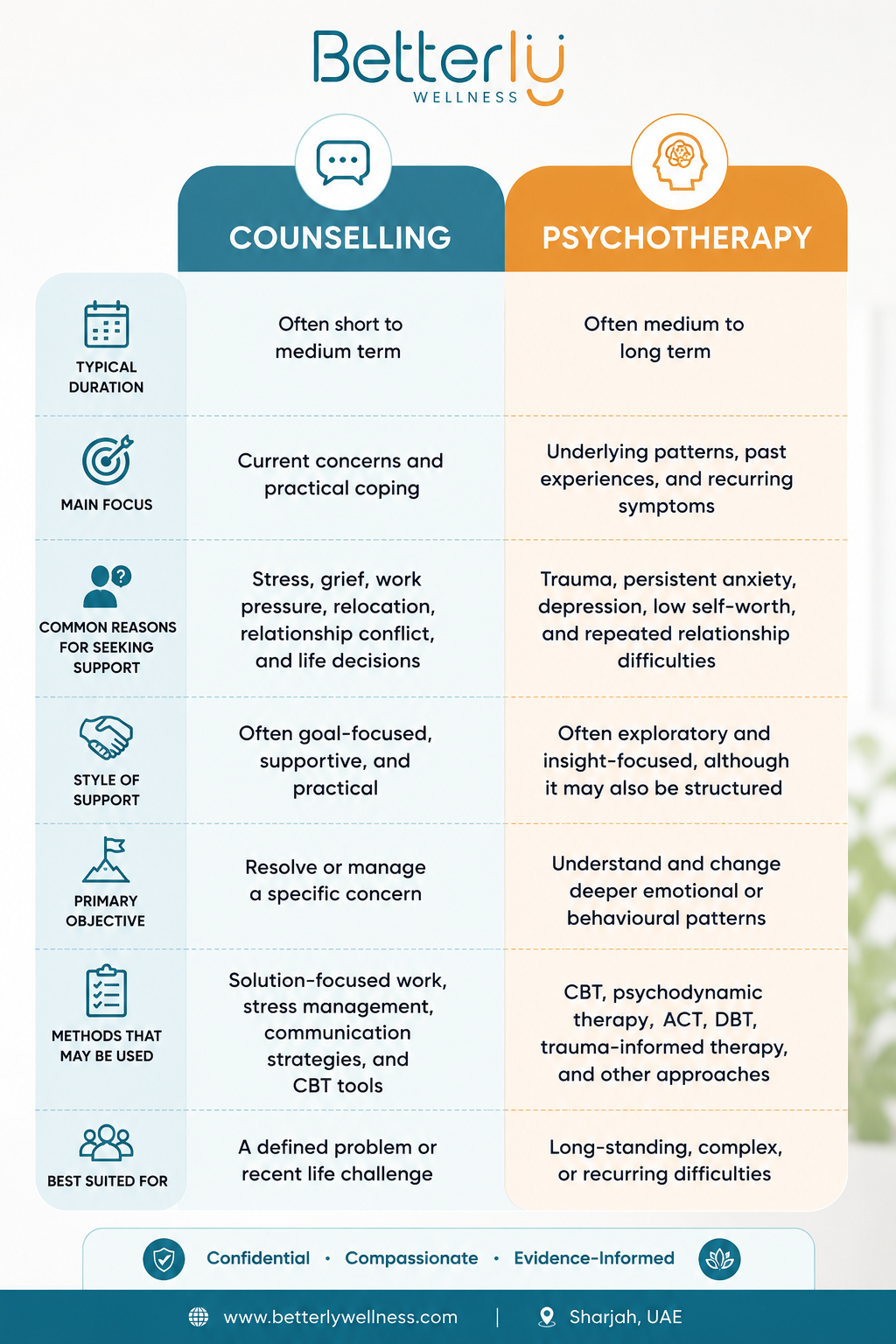
These descriptions are general rather than fixed rules. Some counsellors work with long-term concerns, while some psychotherapy programmes are brief and highly structured. The professional’s qualifications, therapeutic approach, and understanding of your needs matter more than the label alone.
Why Mental Health Support Matters in the UAE
Living in the UAE can offer opportunity, security, professional growth, and access to an international community. It can also involve pressures that are difficult to discuss openly.
People may be managing demanding work schedules, relocation stress, family responsibilities, financial commitments, academic expectations, cultural adjustment, loneliness, or the emotional impact of living far from familiar support systems.
The World Health Organization describes mental health as a state of wellbeing that helps people manage the stresses of life, use their abilities, learn, work, and contribute to their communities. Mental health is therefore not limited to the absence of a diagnosed condition. It affects daily functioning, relationships, decision-making, and overall quality of life.
Many people delay seeking support because they believe they should be able to manage on their own. Others worry that speaking to a therapist means that their problem must be severe.
In reality, people seek counselling services in the UAE for many different reasons. Some want support during a difficult period. Some need counselling for anxiety or depression. Others want relationship counselling, help with emotional regulation, or a clearer understanding of patterns that continue to affect their lives.
You do not have to wait for your situation to become unbearable before speaking with a professional.
What Is Counselling?
Counselling is a collaborative form of support that often focuses on a specific concern, recent experience, or current life challenge.
A counsellor helps you discuss what is happening, understand your emotional response, identify available choices, and develop healthier coping strategies. The purpose is not to tell you what to do or offer generic advice. Counselling creates a structured space in which you can explore a problem without judgment or pressure.
You may seek counselling and psychotherapy services for concerns such as:
- Work-related stress or burnout
- Grief and bereavement
- Relocation or adjustment difficulties
- Relationship conflict
- Family pressure
- Parenting stress
- Academic or examination pressure
- Low confidence
- A major life decision
- Difficulty setting boundaries
- Emotional overload
For example, someone who has recently moved to Sharjah may feel isolated despite being surrounded by people. Counselling can help that person process the transition, rebuild a sense of connection, and establish routines that support emotional wellbeing.
Someone experiencing work pressure may use counselling to recognise stress triggers, communicate more effectively, set realistic boundaries, and prevent burnout from becoming more serious.
People also use counselling for anxiety, counselling for depression, or emotional support following a significant change. Whether counselling is the right starting point depends on the nature, severity, and duration of the concern.
When Counselling May Be Right for You
Counselling may be appropriate when your concern feels recent, specific, or connected to an identifiable event.
You might consider counselling if:
- You are struggling with a particular situation
- You need support making an important decision
- Work stress is affecting your sleep or mood
- You are grieving a loss
- You are finding it difficult to adjust to life in the UAE
- Conflict is affecting a relationship or family
- You feel emotionally overloaded
- You want practical strategies for managing stress
- You need a confidential place to talk
- Your usual coping methods are no longer helping
You do not need to be in crisis. Many people searching for a therapist in Sharjah simply want to understand their feelings before the problem becomes more difficult to manage.
Betterly Wellness provides individual counselling and psychotherapy for concerns including stress, anxiety, low mood, relationship difficulties, trauma, sleep problems, self-worth, and life transitions.
Couples and families experiencing communication breakdowns, recurring disagreements, emotional distance, or major life transitions may also benefit from family and couple therapy.
What Is Psychotherapy?
Psychotherapy, sometimes called talk therapy, includes a range of evidence-based approaches designed to help people understand and change troubling emotions, thoughts, behaviours, and relationship patterns.
The National Institute of Mental Health explains that psychotherapy can help relieve symptoms, improve daily functioning, and support a better quality of life. The American Psychological Association also describes psychotherapy as a collaborative process built around dialogue with a trained mental health professional.
Psychotherapy may examine both what is happening now and why similar difficulties continue to appear.
For example, you may understand that disagreements make you anxious, but you may not know why a minor conflict leaves you feeling rejected for several days. You may recognise that you repeatedly enter unhealthy relationships but feel unable to change the pattern. You may function well professionally while privately experiencing shame, fear, emotional numbness, or low self-worth.
Psychotherapy gives you time and professional support to explore these experiences safely.
People often seek psychotherapy for:
- Persistent anxiety
- Depression or recurring low mood
- Trauma or distressing past experiences
- Panic attacks
- Obsessive thoughts or compulsive behaviour
- Long-standing low self-esteem
- Attachment or trust difficulties
- Emotional numbness
- Repeated relationship patterns
- Unresolved grief
- Strong reactions that feel difficult to control
- Personality-related or identity concerns
When choosing a psychotherapy clinic in the UAE, consider the qualifications of the professional, the therapeutic methods used, the clinic’s assessment process, and whether you feel safe and understood.
Betterly Wellness’s Clinical Psychology Department provides counselling, psychotherapy, family therapy, and psychological assessment services in Sharjah.
When Psychotherapy May Be Right for You
Psychotherapy may be worth considering when a concern has continued for months or years, keeps returning, or affects several parts of your life.
You may benefit from psychotherapy if:
- Anxiety appears without an obvious reason
- Low mood continues for several weeks or returns frequently
- The same relationship difficulties keep repeating
- Past experiences continue to affect your present life
- You struggle to trust people or maintain closeness
- You frequently feel ashamed, inadequate, or emotionally numb
- Small events trigger reactions that feel unusually intense
- You rely on avoidance, compulsive behaviour, or unhealthy habits to cope
- You understand the problem intellectually but still cannot change it
- Your symptoms affect work, sleep, relationships, or daily functioning
Psychotherapy does not require you to discuss everything immediately. A trained professional should work at a pace that feels emotionally manageable while helping you understand what is maintaining the problem.
What Are the Benefits of Talk Therapy?
Talking with a trained professional is different from venting to a friend. Friends can provide care and comfort, but therapy offers structure, clinical knowledge, professional boundaries, and a process designed around your goals.
Talk therapy may help you:
- Recognise emotional and behavioural triggers
- Understand unhelpful thought patterns
- Develop healthier coping strategies
- Communicate needs more clearly
- Set and maintain boundaries
- Manage stress, anxiety, or low mood
- Improve relationship patterns
- Process grief or painful experiences
- Strengthen confidence and self-awareness
- Make decisions with greater clarity
- Improve daily functioning
Therapy is not only about discussing the past. Depending on the approach, sessions may include practical exercises, behaviour changes, communication practice, grounding techniques, thought records, emotional regulation skills, or tasks to complete between appointments.
The specific benefits and time required will vary from person to person.
What Is CBT Therapy?
Cognitive Behavioural Therapy, commonly called CBT, is a structured form of psychotherapy that examines the relationship between thoughts, emotions, physical reactions, and behaviour.
For example, a person may think:
- “I am going to fail.”
- “Everyone will judge me.”
- “Something bad is about to happen.”
- “I cannot cope with this.”
These thoughts can contribute to anxiety, avoidance, physical tension, low confidence, or panic. Avoiding the situation may provide temporary relief, but it can also reinforce the original fear.
CBT helps you identify these cycles, examine whether your thoughts are accurate or helpful, and practise more balanced responses. It may also involve gradual behavioural changes, problem-solving, exposure exercises, or skills for managing difficult emotions.
CBT therapy may be considered for concerns such as:
- Anxiety
- Depression
- Panic attacks
- Phobias
- Stress
- Overthinking
- Low confidence
- Sleep-related difficulties
- Obsessive or compulsive patterns
- Avoidance behaviour
CBT is not simply “thinking positively.” It involves examining patterns carefully and testing healthier responses in real situations.
At Betterly Wellness, a therapist may include CBT therapy within an individual treatment plan when it is suitable for the client’s symptoms, preferences, and goals. Betterly’s listed areas of expertise include Cognitive Behavioural Therapy alongside other therapeutic approaches.
What Is Emotional Therapy?
“Emotional therapy” is commonly used as an informal umbrella term rather than the name of one specific clinical method.
It generally refers to therapy that helps you recognise, understand, express, tolerate, and regulate emotions more effectively. Depending on your needs, a therapist may use elements of CBT, emotion-focused therapy, Acceptance and Commitment Therapy, Dialectical Behaviour Therapy, mindfulness-based approaches, or other recognised methods.
Emotional therapy may be useful if you:
- Feel overwhelmed by emotions
- Become anxious or angry very quickly
- Find it difficult to identify what you are feeling
- Suppress emotions until they become unmanageable
- Feel detached or emotionally numb
- Avoid conflict even when your needs are not being met
- Struggle to express sadness, fear, disappointment, or anger
- Experience physical tension when under emotional pressure
Some people grow up believing that showing emotion is a weakness. Others learn to remain calm for everyone around them while ignoring their own needs.
Over time, unprocessed emotions may contribute to exhaustion, irritability, relationship strain, avoidance, or difficulty concentrating. Therapy can help you respond to emotions with greater awareness rather than fear or impulsivity.
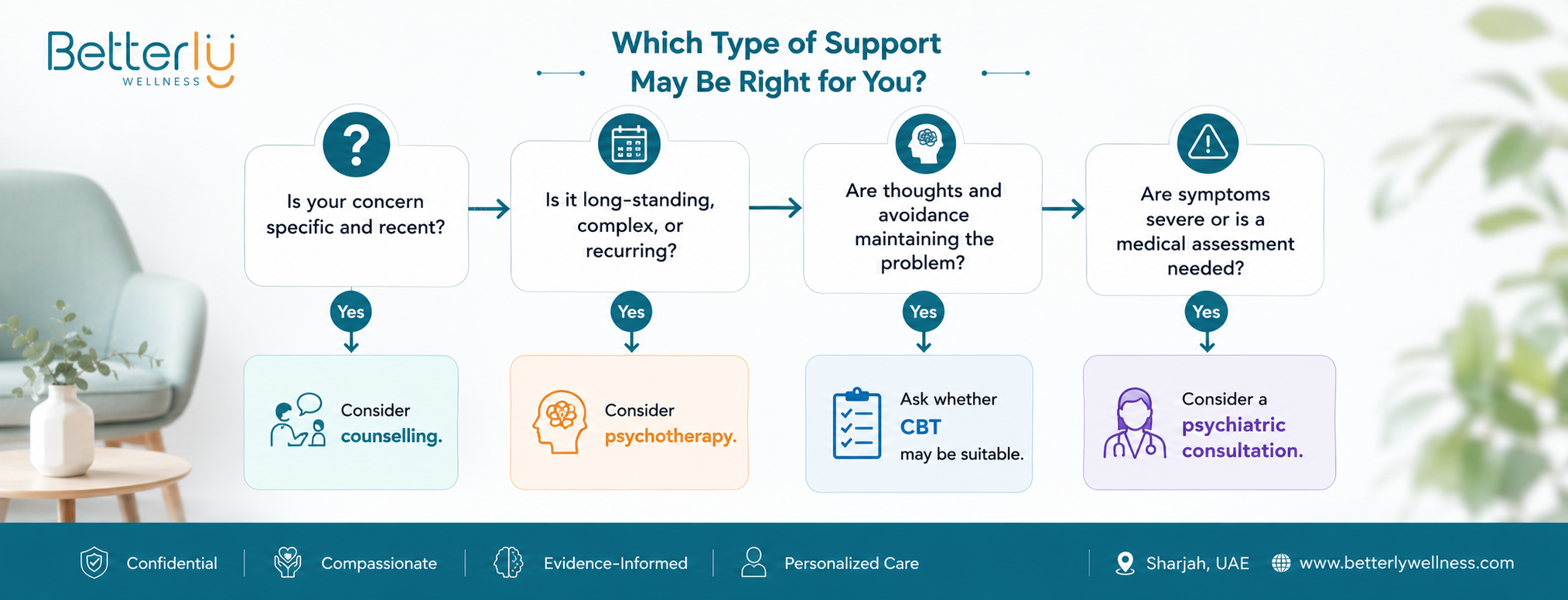
Do You Need Counselling, Psychotherapy, CBT, or Psychiatry?
You do not need to diagnose yourself or select the perfect treatment before your first appointment. A professional assessment can help clarify the most suitable starting point.
Counselling may be a good starting point when:
- You have a specific current problem
- The difficulty began recently
- You want practical coping strategies
- You need support with grief, work stress, adjustment, or relationships
- You have a clear goal for therapy
Psychotherapy may be more suitable when:
- The problem is long-standing or keeps returning
- Past experiences continue to affect you
- You notice recurring emotional or relationship patterns
- Anxiety, depression, trauma, or low self-worth affects several areas of life
- You want deeper understanding as well as symptom relief
CBT may be worth discussing when:
- Thoughts and avoidance patterns are maintaining anxiety
- You want structured and goal-focused sessions
- You experience panic, phobias, overthinking, or low confidence
- You value practical exercises between appointments
Relationship counselling may be appropriate when:
- The same disagreements keep returning
- Communication has become tense or distant
- Trust has been affected
- A major transition is putting pressure on the relationship
- You and your partner want to strengthen the relationship before problems escalate
A psychiatric consultation may be appropriate when:
- Symptoms are severe or significantly affect daily functioning
- There are major changes in mood, sleep, energy, concentration, or behaviour
- Therapy alone has not provided enough improvement
- A medical evaluation or medication assessment may be needed
- A therapist or doctor recommends psychiatric input
A psychiatrist is a medical professional who can assess mental health conditions and prescribe medication when clinically appropriate. Betterly Wellness offers psychiatry services in Sharjah, including evaluation, personalised treatment planning, medication management where required, and therapeutic support.
What to Expect at Betterly Wellness
Your first appointment is an opportunity to understand what you have been experiencing and what kind of support may help.
The professional may ask about:
- What brought you to therapy
- How long the concern has been present
- How it affects work, sleep, relationships, or daily routines
- Relevant medical or mental health history
- Major life changes or stressors
- Previous therapy or treatment
- Your goals and expectations
- Whether there are any immediate safety concerns
You do not need to explain everything perfectly. Many people begin with, “I am not sure where to start.” That is enough.
You can share information at a pace that feels manageable. The purpose of the first session is not to force a label on your experience. It is to understand the concern, assess your needs, and discuss appropriate options.
Based on that assessment, the recommendation may include counselling, psychotherapy, CBT, relationship counselling, psychiatric support, or a combined approach.
Betterly Wellness in Sharjah provides access to clinical psychology, psychiatry, individual therapy, couple and family therapy, and other mental health services through a multidisciplinary team.
How to Choose a Therapist in Sharjah
Finding the right professional involves more than searching for the closest counselling clinic in Sharjah.
When choosing a licensed therapist in the UAE, consider:
- Professional qualifications
Check the therapist’s education, clinical training, professional role, and areas of practice. - Experience with your concern
A therapist who regularly works with anxiety may use a different approach from someone specialising in family conflict, trauma, or child development. - Therapeutic method
Ask whether the therapist uses CBT, psychodynamic therapy, ACT, solution-focused therapy, couple therapy, or another approach. - Personal comfort
You should feel respected, listened to, and able to ask questions. - Treatment goals
A good professional should explain what the sessions will focus on and how progress will be reviewed. - Confidentiality and boundaries
Ask how personal information is handled and what the limits of confidentiality are. - Practical compatibility
Consider appointment availability, location, language, online or in-person options, and session frequency.
The NIMH recommends asking prospective therapists about qualifications, treatment approach, goals, expected duration, and how progress will be assessed.
Why Choose Betterly Wellness in Sharjah
Betterly Wellness provides mental health support for people who want greater clarity, emotional stability, healthier relationships, and practical ways to manage difficult experiences.
The clinic offers access to:
- Individual counselling and psychotherapy
- Clinical psychology
- Cognitive Behavioural Therapy and other therapeutic approaches
- Psychiatry consultations
- Counselling for anxiety and depression
- Relationship counselling
- Couple and family therapy
- Psychological assessments
- Child and adolescent mental health support
Betterly Wellness is located at Office No. 101, Al Maha Building, Muwaileh Commercial, Sharjah. Its official contact page provides telephone, email, and appointment details for people seeking support.
Take the First Step Towards the Right Support
You do not need to wait until emotional pressure begins affecting every part of your life.
Counselling can help you respond to a current difficulty with greater clarity and stronger coping skills. Psychotherapy can help you understand deeper patterns and work towards lasting change. CBT can provide a structured way to address unhelpful thought and behaviour cycles. Psychiatric support may be appropriate when a medical assessment or medication review is required.
You also do not need to make that choice alone.
If you are unsure whether counselling or psychotherapy is right for you, the experienced mental health professionals at Betterly Wellness can help you choose an appropriate approach.
Book a confidential consultation today.
This article is intended for general education and does not replace an individual mental health assessment. If you or someone else may be in immediate danger, contact local emergency services or visit the nearest emergency department.
Related Articles
Frequently Asked Questions
Counselling often focuses on a specific current issue, such as stress, grief, work pressure, relationship conflict, or a life transition. Psychotherapy may explore longer-standing symptoms, past experiences, trauma, beliefs, and recurring emotional or relationship patterns. There is some overlap, and the recommended approach depends on your assessment and goals.
Counselling may help if stress, grief, relationship difficulties, relocation, family pressure, low confidence, or work concerns are affecting your wellbeing. You do not need to be in crisis. Seeking support early can help you understand the problem and develop healthier coping strategies.
Counselling may help people understand symptoms, identify triggers, strengthen coping skills, and make supportive changes. The most appropriate care depends on symptom severity, duration, medical history, and daily impact. Some people may benefit from psychotherapy, CBT, psychiatric assessment, or a combination of services.
CBT is a specific, structured form of psychotherapy that focuses on connections between thoughts, emotions, physical reactions, and behaviours. General counselling may use a wider range of supportive and problem-solving methods. A counsellor or psychologist may also incorporate CBT techniques into sessions when appropriate.
There is no fixed number of sessions. Counselling for a specific concern may be relatively brief, while psychotherapy for complex or long-standing patterns may continue for longer. Your therapist should discuss goals, session frequency, expected duration, and progress reviews with you.
A psychologist or therapist may be suitable when you want counselling, psychotherapy, CBT, emotional support, or behavioural strategies. A psychiatrist may be appropriate when symptoms require a medical assessment, diagnosis, medication evaluation, or combined psychiatric and psychological care.
Yes. Betterly Wellness provides couple and family therapy for communication difficulties, recurring conflict, emotional distance, trust concerns, and major life transitions. Sessions are designed around the couple’s or family’s needs and goals.
Connect with Us